The exhibition
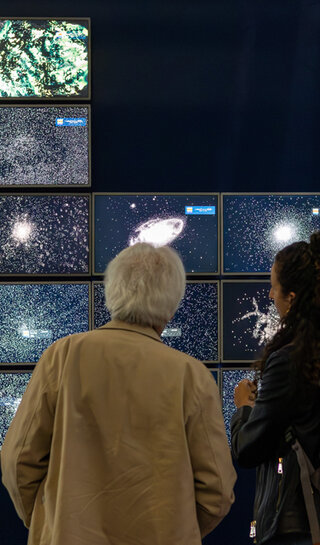
At the entrance to the exhibition, three LCD screens forming a fresco inspired by the Euclid telescope observations immediately capture our attention. The surface cracks and dents form shapes that evoke the invisible structures of the universe, and more especially the dark energy this scientific programme is seeking to understand. This destruction is a recurring motif of Gillian Brett’s work, but in no way denies the image; it transforms it into a phenomenon. Each point of light the viewer discovers refers to a real star, which the artist reveals by piercing the surface of the screen.
The installation continues with an interpretation of the Messier Catalogue, presented as a set of fragmented screens. Developed in the 18th century to differentiate comets from other astral objects, this catalogue was born of an erroneous observation: Charles Messier mistook the Crab Nebula for Halley’s Comet. This founding error becomes a turning point here; from observation to reality and projection, the artist offers an interpretation which will be added to over time with her future work.
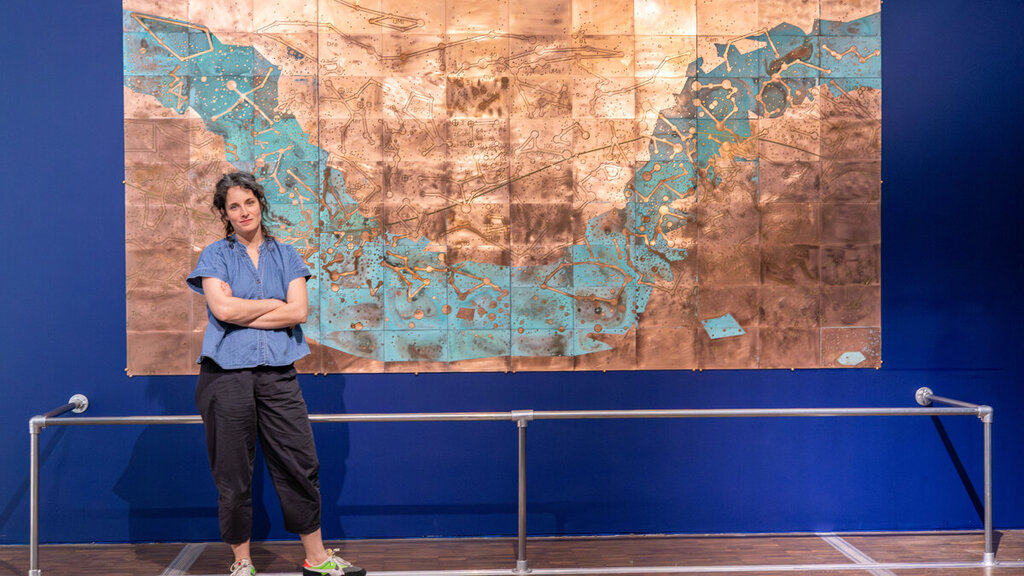
Opposite these images, a fresco made of circuit boards suggests a functional celestial map of Messier objects. The copper lines imitate the principles of astronomical positioning (numbering, orientation and deep-sky mapping), while translating them into an electronic vocabulary. They thus create a parallel between the information networks of our everyday digital tools and cosmic structures. Patches of verdigris outline the Milky Way. The artist obtains this effect through an electrolysis process: the fresco plates are immersed in a saline solution, and the copper ions, set in motion by an electric current, slowly migrate to the surface and settle elsewhere in the room, on an ensemble of three-dimensional supernovas.
Supernovas play a key role in matter diffusion in the universe. When they explode, their chemical elements are released and scattered into the interstellar medium. This cosmic ‘pollination’ is mirrored here in the electrochemical process triggered by the artist: the copper moves around, comes to rest and transforms surfaces. Drawing on astrophysical data, the stellar objects revealed by the artist materialise phenomena that are generally limited to an image. Their physical presence enters into dialogue with the Messier Catalogue screens, from the explosion of the screen to the explosion of the star.
This exploration extends to contemporary concerns, particularly that of satellite ‘mega-constellations’. Designed to ensure global internet coverage, these infrastructures create a new, man-made layer around the Earth; a sky saturated with technical objects causing light pollution, interferences and largely-underestimated environmental impacts. In this context, Full Screen can be seen as the image of a technological dome in orbit, where the promise of universal connection radically transforms our access to reality.
Lastly, three ceiling-mounted screens, evoking a control system, force us to raise our eyes and adopt the posture of stargazers.
Full Screen thus questions the notion of direct access to the world. Here, the sky can no longer be contemplated; it is revealed through screens and recomposed in the very circuits that now organise our concept of infinity.
Gillian Brett
Born in Paris in 1990, Gillian Brett lives and works in Marseille.
The practice of Gillian Brett is dedicated to analysing the delicate and complex relationship between the human being and technology, reflecting specifically on the ways and the processes by which it inevitably shapes and influences the surrounding world. Her objects and installations offer a poetic questioning of our attitude to progress and its excesses, highlighting the flaws of a technology-dependent industrial society.
A graduate of Villa Arson in Nice, she was awarded an Institut de France scholarship and pursued her studies at Goldsmiths College in London. There, her work took on a more critical aspect. She turned her attention to discarded LCD screens and explored the philosophy of techniques and radical ecology, influenced by Günther Anders, Jacques Ellul and Bernard Charbonneau.
She then took part in several residencies around the world and her work has been exhibited by many international institutions, such as the KW in Berlin, Munch Museum in Oslo, Kunsthal Charlottenborg in Copenhagen and Van Gogh Foundation in Arles. She has won several awards, including the Villa Noailles Révélations Emerige Prize, the Prix Dauphine for Contemporary Art, and Artissima’s Xiaomi Award.
Practical information
-
€15 | €12 | Our prices
-
From age 9
-
Bilingual exhibition (French, English)
-
10 am - 7 pm
Accessibility
- Accessible to visitors with reduced mobility
Plan your visit
This exhibition area can be accessed by lift (level 2). Small pushchairs are allowed inside the museum.