


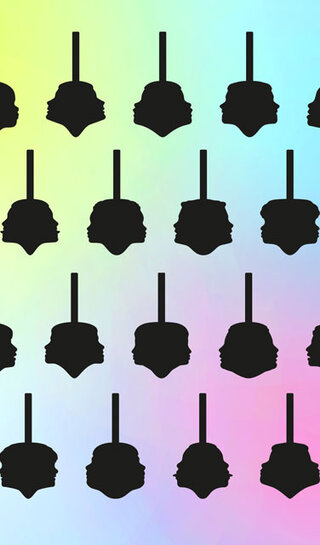
The exhibition

To develop his project, Le Gentil Garçon studied what are known as “seditious objects”: small sculpted pieces, often carved from turned wood, whose enigmatic shape only reveals its meaning when lit in a particular way, casting the shadow of a face seen in profile. Emerging at the end of the eighteenth century in England and in France during the Revolution of 1789, these objects allowed their owners to secretly show allegiance to forbidden or controversial political figures. These faces were hidden within everyday objects designed around an axial symmetry: cane handles, chess pieces or wax seals. For his exhibition, the artist applies this same process in an original way to the making of spinning tops, whose axial symmetry is, of course, fundamental in explaining how they behave once set in motion.
The work conceived specifically for the exhibition is an installation combining sculpture, video, and kinetic and light-based devices. Its creation process involves the participation of twenty-four children as well as artisanal and engineering skills.
At the heart of the installation is a motorised sculpture evoking the famous bicycle wheel mounted on a stool by Marcel Duchamp. The reference is deliberate: Le Gentil Garçon is consciously placing himself in the tradition of that artist. Known for introducing everyday objects into the world of art, Marcel Duchamp was equally interested in the shadows cast by these objects, and developed several rotating and optical devices.
Le Gentil Garçon’s system also draws inspiration from fairground machines on the boundary between science and spectacle: shadow theatre, optical toys, magic lanterns… The spinning tops, their ever-shifting images constantly eluding us, are swept into a slow waltz, a cosmic ballet whose appearance constantly renews itself. A large video projection and a poem by the physicist James Maxwell, Ode to the Spinning Top, written at the age of thirteen, bear witness in the exhibition to this celestial feeling inspired by the motion of spinning tops.
Just as a glass prism reveals the composition of white light, the working of the spinning top demonstrates phenomena that our limited senses had previously kept hidden. We perceive only a fragment of reality. A face that never shows itself from the front. In this game of deception, childlike curiosity and science lead us to the discovery of all the hidden beauties the world promises.
Practical information
-
From age 6
-
French exhibition
Accessibility
- Accessible to visitors with reduced mobility